Dulux colour awards 2026
Colour schemes that match and enhance the environment were winners this year, in the 40th anniversary of the Dulux Colour Awards, which recognise innovative, original and ambitious use of colour in the built environment. We take a look at the residential (interior and exterior) winners.
Poised high in the treetops of the Yarra Valley, ‘The View’ in Mount Evelyn was named Residential Interior Winner, for its ‘rich, earthy palette derived from the neighbouring landscape’.
According to judge Sarah-Jane Pyke, designers Studio Shields chose hues for their ‘nuanced tonal depth and capacity to shift through calibrated tints and shades, echoing the hues of oxidised earth, eucalyptus canopy, dry grasses and shifting skies to create an interior that is symbiotic with its natural context.
“Colour is ingrained in structural and joinery elements, so its presence is felt as much as seen. It is a mature palette, featuring unlikely pairings of chartreuse and olive, burgundy and earthy red, yellow and murky green, applied in subtle shifts that build a cohesive tonal narrative throughout the home.
“Again, drawing upon nature’s organisation, the deeper, grounding tones are applied at lower levels and tempered with a powdered blue on the ceiling, with the elevating impact of a vast open sky”, Pyke noted.
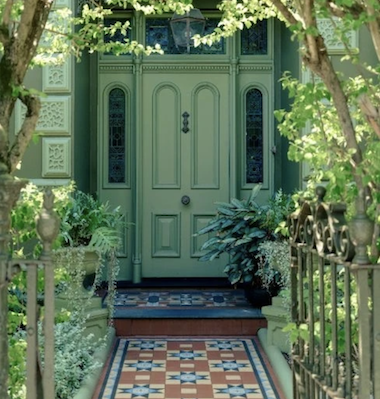
The ‘Single Residential Exterior Winner’ award went to Studio Prineas for its Nithsdale project.
Of the restored 1890s villa, judge Ben Peake said that the use of bold, tonal colour has ‘restored coherence to the house, allowing architecture, planting and colour to operate as a continuous system once again.
“In Victorian architecture, deep greens occupied a regulated role, while in contemporary times, ‘heritage’ palettes often deploy these tones cautiously rather than with the confidence of the nineteenth-century. At Nithsdale, these conventions are eschewed and what was once constrained to details now dominates, with two Dulux greens, Bronze Icon and Tambo Tank, drenching the exterior”, Peake noted.
“Rendered masonry, timber, quoining, and wrought iron are chromatically unified, with difference expressed through finish rather than colour, such as enamelled iron juxtaposed with matte walls.
“Crucially, the greens are deliberate selections drawn from the immediate native landscape and species indigenous to Wangal Country, rendering the house as an element within foliage rather than distinct from it.”