Landscaping your night garden
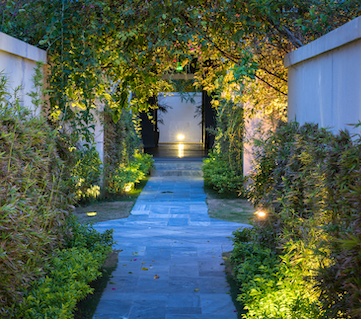
Carefully planned garden lighting can create visually open spaces at night, with dramatic features or intimate nooks just like a well-lit room. Lit effectively, parts of the garden at night can become another room of your house, provide long vistas or delight with surprising glimpses from within the interior.
Begin designing your lighted landscape by considering the potential ‘canvas’. What will visitors or passers-by see? What do you want to see from inside the house? Different angles, floors and even window size offer a range of possibilities.
Placement is an important element. Ideally, we don’t want to see the actual light source, but rather the effect on its surroundings, a revealing of the exterior ‘architecture’ of the garden at night or an inviting passage through that garden.
The effect you are looking for will determine the sort of lights used and their placement. As a general rule, rather than having indiscriminate flood lighting which is expensive, wastes energy and creates light pollution, use luminaires with narrow beam angles to pick out significant elements.
Larger gardens benefit from lights positioned above head height for an overall spatial quality. In small gardens and spaces, lights mounted below eye level create intimate and intriguing pools of light while fixtures designed to merely glow help to mark out boundaries or passageways.
Lighting walls behind plantings or sculpture with a wash of light will throw those shapes into dramatic silhouette. Move the fixture further out from the wall for a more pleasant, even wash. Aim the centre of the beam at the centre of the object you are lighting and allow the shadows to play their own role.
Lighting up into canopies will help to create a sense of enclosure, while lighting down from the tree onto the ground will, depending on the branch structure of the tree, provide exciting shadows on the ground and reveal the architecture of the tree.
It is important, also, to place fixtures so light doesn’t shine into neighbouring windows.
Remember that lights can become hot, so should be placed away from surfaces and plants that could be heat damaged or are potentially flammable. Adequate airflow is important for maintaining a suitable temperature for both the fixture and lamp.
When lighting into trees, shrubs or ponds, consider also that light will affect the natural life cycle of that ecosystem. Dimming and time control systems might help prevent too much disturbance to these animals and plants. In sensitive natural environments, contact your local council for information on the breeding cycles of local fauna.
For continuous runs of smaller sculptured shrubs such as box, use low in-ground fixtures which light the vertical plane in a soft even wash, creating a perimeter edge. Alternatively, light the horizontal plane of this kind of shrubbery by using narrow beam accent luminaires mounted on brackets to enable the light to ‘catch’ the top of the shrubbery.
Specific plants or elements that you want to highlight in the garden may need to have accent luminaires with narrow or medium beam spreads which highlight either the shape or the texture of the plant.
As with any garden design, strive for simplicity, harmony and the dignity of the space - don’t spoil the effect with too many focal points.
Water features and pools can also be part of the night landscape with appropriate lighting. Build the pictures from the primary point from which the pool will be viewed but don’t neglect other possible vantage points. Place lights behind the jet to ‘catch’ the water as it falls.
Pergolas, niches and statuary can be lit to enhance your garden but select carefully what is to be featured. Uplight with care to avoid unnatural shadowing on statues or people or animals - use a secondary fill light to balance the shadows.
Good lighting will add to the quality of your immediate environment, extending your perception of space so you are no longer surrounded by dark voids. Seen from the street, well-designed external lighting will help to set the home into the landscape, locate paths and detail the landscape.